








Two days is enough to see the core of Fez properly, as long as you split it the way the city is split. Day one is Fes el-Bali, the walled medina founded in the 9th century: you enter at the top through Bab Bou Jeloud and walk downhill through two Marinid madrasas, the carpenters' fondouk, the doors of the Qarawiyyin and the coppersmiths' square to the Chouara tannery, then take a taxi up to the Merinid Tombs for sunset. Day two is Fes el-Jdid, the royal town the Marinids built next door in 1276: the palace gates, the Mellah and its synagogue, the Grande Rue, the Jnan Sbil gardens and the Dar Batha museum, which reopened in 2025 after six years of work.
The order matters more here than in most cities. Fes el-Bali slopes down from west to east, so the route below is downhill all day, and the two halves do not overlap. Each day is about 2.5–3 km on foot, but medina walking is slow: narrow lanes, steps, mules and handcarts. The plan assumes a Saturday and a Sunday, which avoids the two worst clashes: Friday, when many medina shops close and the madrasas shut for midday prayer, and Saturday afternoon for the Jewish cemetery, which is closed on the Sabbath. If your days fall differently, check the notes at the end of each section.
Know before you go
- Almost nothing needs booking. Dar Batha sells tickets online, but you can buy them at the door. The madrasas, the Nejjarine museum and the tannery terraces are all pay-at-the-door or free.
- Book a licensed guide for the first morning if you are nervous about getting lost. Only licensed Moroccan guides may legally guide in Morocco; ask your riad or the tourist office, and agree the price and the end point first. There is no official rate card: private half days sold online run about 300–750 MAD, with entry fees on top.
- Bring cash. Riads take cards; the souks, entry desks, taxis and tips are cash in dirhams (MAD). ATMs at the medina gates and in the Ville Nouvelle take foreign Visa and Mastercard.
- Non-Muslims cannot enter mosques or the Zaouia of Moulay Idriss II. The madrasas are open to everyone, but their prayer halls are not. You will see the Qarawiyyin through its doorways, and the route is planned around that.
Day 1, 09:00 — Bab Bou Jeloud: in at the top
Take a red petit taxi to Bab Bou Jeloud and insist on the meter (the word drivers recognise is koontoor). Taxis cannot enter the medina, and this square is where most visitors are dropped. From the train station in the Ville Nouvelle it is about 3 km, and a fare across town is typically 15–20 MAD.
Bab Bou Jeloud looks ancient but was finished in 1913, under the French administration, beside an older gate that still stands next to it. The outside is faced with blue zellige tiles, the inside with green, the colour of Islam. Through the arch you see the minarets of the Bou Inania madrasa and the Sidi Lahzen Lyoussi mosque, framed as if on purpose.
The lane straight ahead is the start of Talaa Kebira, the long main street that runs down the medina to the Qarawiyyin. Keep it in mind: if you lose your way at any point today, ask for Talaa Kebira or follow the flow of people downhill.
 Bab Bou Jeloud from the square outside, the usual taxi drop-off for the upper medina. Image: Yair Haklai, CC BY-SA 4.0, via Wikimedia Commons.
09:15 — Bou Inania Madrasa: the finest building you can enter
Bou Inania Madrasa is about 150 m in, on the right of Talaa Kebira. The Marinid sultan Abu Inan Faris built it between 1350 and 1355 as a college for students of religion and law. It was also the only madrasa in Morocco to serve as a Friday mosque, which is why it has a minaret.
Entry is 20 MAD. The building is open roughly 9:00–18:00 but closes at prayer times and for longer around Friday midday prayer; no official timetable is published. Non-Muslims may walk the marble courtyard and look into the prayer hall across a small channel of water, but not enter it. Allow 30 minutes for the carved cedar, the stucco and the zellige that cover every surface below the roof line, and for the students' cells upstairs where they are open.
Opposite the entrance, on the wall above the lane, is the Dar al-Magana water clock, completed in 1357. It no longer works: the 13 bronze bowls that once struck the hours were taken down in the late 20th century, and only the restored wooden facade remains.
 Carved stucco in the courtyard of the Bou Inania Madrasa, with its minaret above the arch. Image: Petar Milošević, CC BY-SA 4.0, via Wikimedia Commons.
Breakfast option: Café Clock, in Derb el-Magana just below the water clock, has been open since about 2007 and is one of the few places in the upper medina with a long track record. It is a good place for coffee before you start or for a break before the walk down.
10:00 — Down Talaa Kebira
The next kilometre is the medina as most people picture it: a lane sometimes two metres wide, lined with butchers, bakers, spice sellers, leather and brass, and roofed in places with cane. Walk on the right, keep your bag in front of you, and step aside when you hear "Balak!": it means "make way", and a mule or a handcart loaded with gas bottles is about to pass.
Shopkeepers will invite you in, and young men may offer to show you the way, the tannery or "the Berber market, only today". You can say no. Unlicensed guiding is illegal, and a firm, friendly "la, shukran" (no, thank you) is enough. Ask before you photograph anyone, including traders at their stalls.
 Talaa Kebira, the main street of Fes el-Bali, running downhill from Bab Bou Jeloud towards the Qarawiyyin. Image: Jorge Franganillo, CC BY 2.0, via Wikimedia Commons.
10:45 — Nejjarine: the carpenters' fondouk and a roof terrace
Where the street meets the carpenters' quarter, follow the smell of cedar to Place Nejjarine. The tiled fountain on the square dates from the 19th century. Beside it stands the Funduq al-Najjarin, a merchants' inn completed in 1711, where traders once stabled animals on the ground floor and slept above. It was restored between 1990 and 1996 and opened in 1998 as the Nejjarine Museum of Wooden Arts and Crafts.
Tickets are 20–30 MAD (sources differ on the current price), and opening hours are roughly 10:00 to 17:00 or 18:00. Inside are carved doors, chests, musical instruments and the tools of the trade, but the building is the main exhibit: three storeys of wooden galleries around a courtyard. Allow 45 minutes, including a mint tea at the rooftop café, which has one of the easiest views over the roofs of Fes el-Bali.
 Place Nejjarine: the 18th-century fondouk, now the woodwork museum, with the tiled fountain to the right. Image: Robert Prazeres, CC BY-SA 4.0, via Wikimedia Commons.
12:00 — The Zaouia of Moulay Idriss II: a shrine you see from the door
About 100 m east is the Zaouia of Moulay Idriss II, the shrine of the ruler who made Fez his capital in the early 9th century and the most important religious site in the city. Non-Muslims may not enter, but you can walk up to the carved cedar doors and look in, and see the green-tiled pyramid roof and the tallest minaret in Fes el-Bali from the lanes around it. The building was rebuilt in 1717–1720 and restored again between 2011 and 2014.
Look for the wooden beams across the lanes at head height around the shrine. They mark the edge of the old sanctuary, where animals were not allowed; you duck under them. On the south side is a grilled window with a slot where pilgrims leave alms.
Lunch: stop around here or near the Attarine. Pick a busy place where locals eat. A plate of tagine or a bowl of bissara (bean soup) costs little, and you are halfway down.
13:30 — Al-Attarine Madrasa
The Al-Attarine Madrasa sits at the bottom of the spice sellers' souk, a few metres from the Qarawiyyin. It is older and smaller than the Bou Inania: Sultan Abu Sa'id Uthman II built it in 1323–1325. It is the more intimate of the two, with zellige, carved stucco and cedar packed tightly into one space. Entry is 20 MAD, and it keeps similar hours to the Bou Inania, roughly 9:00–18:00. Allow 20–30 minutes, and climb to the upper floor if it is open for the view down into the courtyard.
 The courtyard of the Al-Attarine Madrasa, built in the 1320s, with tile, stucco and cedar in three bands. Image: Robert Prazeres, CC BY-SA 4.0, via Wikimedia Commons.
14:15 — The Qarawiyyin through its doors
Al-Qarawiyyin was founded as a mosque in the mid-9th century (sources give 857–859), traditionally by Fatima al-Fihri, a woman from a merchant family from Kairouan. Some historians question parts of that story, and the institution only became a state university in 1963, but it has taught continuously for centuries. Guinness World Records lists it as the oldest existing and continually operating educational institution in the world.
Non-Muslims cannot go inside. The way to see it is through the open doorways on the lanes that surround it, especially the main gate on Derb Boutouil, from where you look across the tiled courtyard to the pavilions and fountains. Do not step over the threshold, and do not photograph people at prayer.
 The courtyard of the Qarawiyyin seen through one of its gates, as far as non-Muslim visitors can go. Image: HMAMOUCHE Asmae, CC BY-SA 4.0, via Wikimedia Commons.
14:45 — Place Seffarine: hammers and the library door
Round the corner, Place Seffarine is the coppersmiths' square, and you will hear it before you see it: craftsmen hammering cauldrons, trays and lanterns under a large tree. On the square is the entrance to the Qarawiyyin library, closed in 2012 and reopened in 2016 after a restoration led by the Fez-born architect Aziza Chaouni. Whether and when visitors can go in now is not published; ask at the door. Also on the square is the Seffarine Madrasa, the first madrasa the Marinids built in Fez, in 1271. It still houses students and is not a sight you can count on entering.
 Place Seffarine, the coppersmiths' square, with the workshops under the plane tree. Image: R Prazeres, CC BY-SA 4.0, via Wikimedia Commons.
15:15 — Chouara Tannery: watch from a terrace
The Chouara Tannery is about 250 m north-east of Place Seffarine, and the lanes will be full of people offering to take you. You do not need them: follow the signs to the tannery or ask for Derb Chouara. The tannery itself is a courtyard of stone vats where hides are soaked, washed and dyed by hand, a method used here for centuries. Since its renovation around 2015–2016 it looks much as it does in photographs.
You watch from the terraces of the leather shops that surround it. A shop assistant will give you a sprig of mint to hold under your nose; the smell is strong. Entry to the terraces is officially free, but a tip is expected: 20–50 MAD per person is the current going rate, and you can ignore anyone who asks for 100 MAD or more. You will be shown jackets, bags and babouches on the way out, and "just looking, thank you" is accepted.
The vats are at their most colourful in the morning, when the dyes are fresh. If that matters to you, swap the day around: take a taxi to Bab R'cif or Bab Guissa in the morning, start at the tannery, and walk the route in reverse, uphill. If you prefer a quieter tannery, Sidi Moussa, near the Zaouia, sees fewer tour groups.
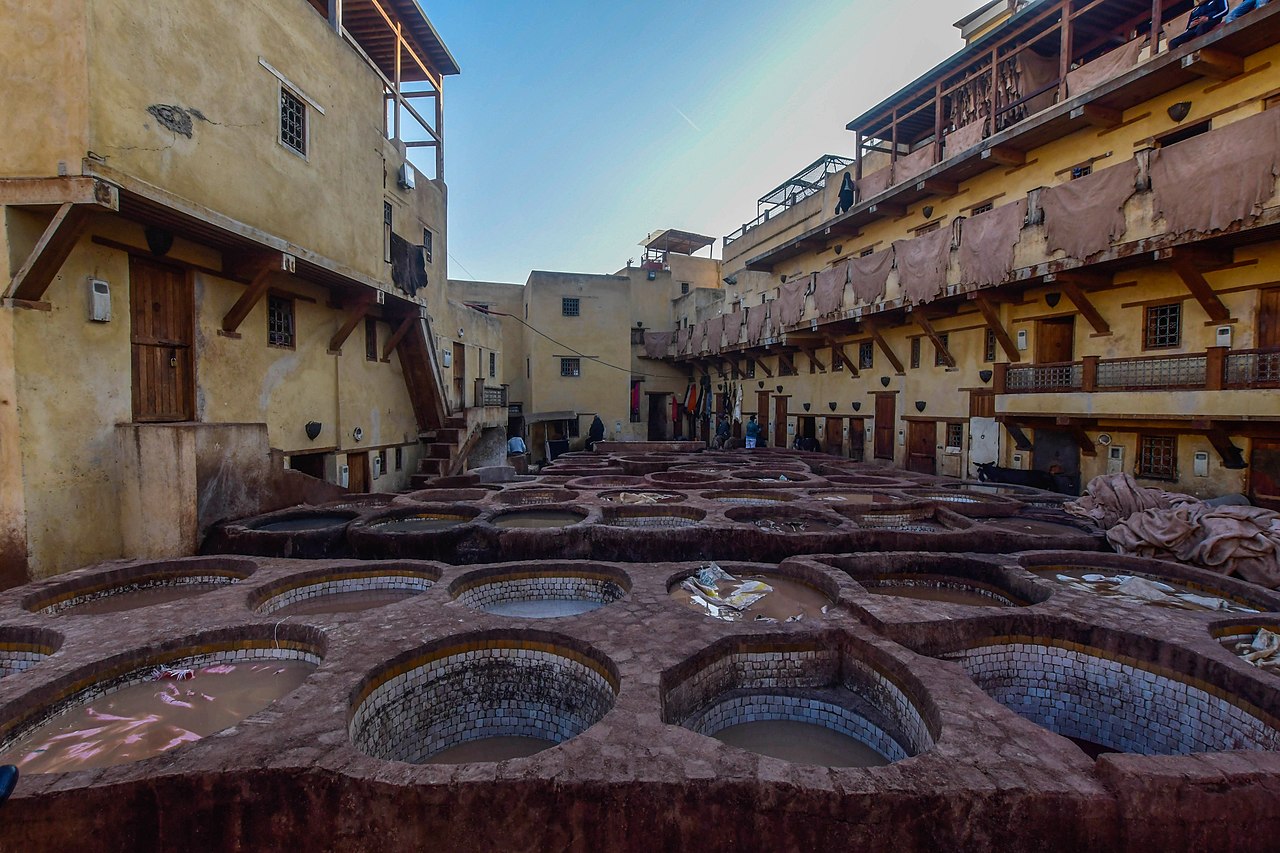 The vats of the Chouara Tannery seen from a leather shop terrace. Image: Houssain tork, CC BY-SA 4.0, via Wikimedia Commons.
17:00 — Sunset at the Merinid Tombs
Leave the medina by Bab Guissa, at the northern edge, and take a petit taxi up the hill to the Merinid Tombs, about a kilometre away. Walking up is possible but steep. The ruined Marinid-era tombs themselves are just shells, but the slope in front of them is the classic view of Fes el-Bali: the whole medina in its valley, with the call to prayer rising from dozens of minarets at sunset.
Go in a group if you can, and leave before full dark. Visitors have reported pickpocketing and muggings here after nightfall, and there are no facilities, so bring water. Just below is Borj Nord, a fortress built in 1582 that has housed an arms museum since 1963; it is listed as open 9:00–18:00 for 20 MAD, but its current opening is not confirmed, so treat it as a bonus.
 The ruins of the Merinid Tombs on the hill north of the medina, the usual sunset viewpoint. Image: Abdul muhib, CC BY 3.0, via Wikimedia Commons.
Day 2, 09:30 — Dar el-Makhzen: the palace gates
Take a taxi to Place des Alaouites in Fes el-Jdid, the royal town Sultan Abu Yusuf Ya'qub founded in 1276 beside the old medina. Fes el-Jdid is flatter and wider than Fes el-Bali, and you can walk it with a map.
The Royal Palace (Dar el-Makhzen) is still a royal residence, and there is no entry. What visitors come for are the gilt-bronze doors set in a wall of zellige and carved cedar on the square. They look old but were made in 1969–1971, when King Hassan II laid out Place des Alaouites. Morning light is best for photographs, and guards will move you on if you go too close.
 Detail of one of the gilt-bronze doors of the Royal Palace on Place des Alaouites, made in 1969–1971. Image: just_a_cheeseburger, CC BY 2.0, via Wikimedia Commons.
10:00 — The Mellah, the Ibn Danan Synagogue and the cemetery
The Mellah, the old Jewish quarter, begins just east of the palace. Fez's Jews moved here from the old medina in the mid-15th century; the date is not certain. Most of the community emigrated in the second half of the 20th century, but the quarter keeps its name and its houses.
The main street, Rue des Mérinides, was cut by the French in 1924 and is lined with houses with wooden and iron balconies facing the street, unlike the inward-looking houses of the medina. About 230 m from the palace, down a side lane, is the Ibn Danan Synagogue, built in the late 17th century and restored in the late 1990s with the World Monuments Fund. A caretaker opens it; some visitors find it shut, and the fee is a donation or up to about 25 MAD. Inside are the carved wooden ark, the tiled walls and a ritual bath (mikveh) below.
At the south-west corner of the Mellah is the Jewish cemetery, with rows of whitewashed tombs and a former synagogue that is now a small museum. It is closed on Saturdays and keeps roughly 9:00–11:30 and 14:30–17:00 on other days; the fee was 10 MAD at last report. Pay only at the gate: men who stop you outside to collect a "fee" are not staff. Allow about 90 minutes for the Mellah.
 Rue des Mérinides in the Mellah, with the street-facing balconies that set the Jewish quarter apart. Image: Robert Prazeres, CC BY-SA 4.0, via Wikimedia Commons.
 The carved wooden ark of the Ibn Danan Synagogue, restored in the late 1990s. Image: R Prazeres, CC BY-SA 4.0, via Wikimedia Commons.
11:30 — Bab Semmarine and the Grande Rue
At the north end of the Mellah, Bab Semmarine, a broad arched gate widened by the French in the 1920s, leads into the Grande Rue of Fes el-Jdid. This is an ordinary shopping street for locals: clothes, household goods, fabric and wedding gear rather than souvenirs, which makes it a calmer walk than Talaa Kebira. It runs north-north-west towards the Old Mechouar and the gardens. It is a good place for lunch at a simple local café.
13:30 — Jnan Sbil Gardens
Jnan Sbil, also called the Bou Jeloud gardens, covers about 7.5 hectares between Fes el-Jdid and Fes el-Bali. It was restored between 2006 and 2010, and reopened in 2010–11. Entry was free at last check, and it is open in daylight. It is usually closed on Mondays, so if your Day 2 falls on a Monday, swap it with the Dar Batha.
Inside are long avenues of palms and orange trees, a bamboo grove, ponds and a restored water wheel. Families picnic here at the weekend. Allow 45 minutes to an hour; it is the best place in Fez to sit down without buying anything.
 The gardens of Jnan Sbil, restored and reopened in 2010–11 after work by the Mohammed VI Foundation. Image: R Prazeres, CC BY-SA 4.0, via Wikimedia Commons.
15:00 — Dar Batha: the Museum of Islamic Arts
Leave the gardens on the medina side. It is about 400 m to Bab Bou Jeloud and another 180 m to Place Batha, where the day ends. Dar Batha is a palace built between 1873 and 1894 for Sultan Moulay Hassan I. After a renovation that began in 2019, it reopened on 26 February 2025 as the Musée Al Batha des Arts de l'Islam, run by Morocco's National Museums Foundation.
It is open every day except Tuesday from 10:00 to 18:00, and tickets cost 60 MAD for foreign visitors (30 MAD for Moroccans, 15 MAD for children). The collection of more than 6,500 objects includes ceramics, carved wood and the minbar (pulpit) of the Bou Inania madrasa you saw yesterday. Allow 90 minutes, including the Andalusian garden in the courtyard.
If your Day 2 falls on a Tuesday, visit the Dar Batha at 10:00 on Day 1 instead, before the Bou Inania: it is two minutes from Bab Bou Jeloud.
 The arcaded courtyard of Dar Batha, the 19th-century palace that reopened as the Museum of Islamic Arts in 2025. Image: R Prazeres, CC BY-SA 4.0, via Wikimedia Commons.
Evening — a hammam
End the weekend the way people in Fez end the week. A public hammam costs around 40 MAD to enter and about 150 MAD with a scrub. Bring flip-flops, a towel and something to wear inside; men and women bathe at different times or in separate sections. A riad or spa hammam is more private and costs from about 350 MAD. Ask your riad which local hammam is used to visitors.
Alternative Day 2: Meknes and Volubilis
If you have seen enough medina, spend the second day on the Roman city of Volubilis. Trains run from Fez to Meknes roughly every hour, take 36–45 minutes and cost about 21–30 MAD in second class. Volubilis has no station: hire a grand taxi or a driver in Meknes for the 30 km trip, or book a driver from Fez for the whole day. Volubilis opens daily about 8:30–18:00, with last entry at 17:30. The ticket was 70 MAD for foreign adults, but fencing and security works began on the site in September 2024, so check the price before you go. Allow a full day.
The weekend at a glance
| Time | Stop | Allow | Book ahead? |
|---|---|---|---|
| Day 1 09:00 | Bab Bou Jeloud | 15 min | No |
| 09:15 | Bou Inania Madrasa | 30–45 min | No (20 MAD at the door) |
| 10:00 | Talaa Kebira walk | 45 min | No |
| 10:45 | Nejjarine museum and roof terrace | 45–60 min | No (20–30 MAD) |
| 12:00 | Zaouia of Moulay Idriss II (outside) and lunch | 90 min | No |
| 13:30 | Al-Attarine Madrasa | 30 min | No (20 MAD) |
| 14:15 | Qarawiyyin doors and Place Seffarine | 45 min | No |
| 15:15 | Chouara Tannery | 30–45 min | No (tip 20–50 MAD) |
| 17:00 | Merinid Tombs at sunset | 1 hour | Taxi |
| Day 2 09:30 | Royal Palace gates | 20 min | No |
| 10:00 | Mellah, Ibn Danan Synagogue, cemetery | 90 min | No |
| 11:30 | Bab Semmarine, Grande Rue, lunch | 90 min | No |
| 13:30 | Jnan Sbil Gardens | 45–60 min | No (closed most Mondays) |
| 15:00 | Dar Batha | 90 min | Optional online (closed Tuesday) |
| Evening | Hammam | 1–2 hours | Ask your riad |
Practical notes
Getting to Fez. Fès–Saïss airport is south of the city. Taxis to the medina cost 150–230 MAD (agree the fare before you get in; a higher rate applies late in the evening), and riads arrange transfers for 200–350 MAD. Bus 16 goes from the airport to the train station, not the medina, for a few dirhams. By train, Casablanca to Fez takes about four hours, with hourly departures; from Tangier the quickest route is the Al Boraq high-speed train to Kénitra and a change there, about 3.5 hours in all; from Marrakech it is about six and a half hours. Check times and fares on oncf-voyages.ma. The station is in the Ville Nouvelle, about 3 km from Bab Bou Jeloud by petit taxi.
Where to stay. A riad inside Fes el-Bali near Bab Bou Jeloud or Batha puts you at the top of Day 1 and the end of Day 2. Ask the riad to meet you at the gate the first time: many are hidden down unmarked lanes.
Which days. Saturday and Sunday is the cleanest weekend. On Fridays many medina shops close, especially in the morning, and the madrasas shut for longer at midday prayer. Dar Batha is closed on Tuesdays, Jnan Sbil on most Mondays, and the Jewish cemetery on Saturdays.
Ramadan and holidays. Ramadan in 2027 is expected to begin around 8 February, with Eid al-Fitr around 9–11 March; Morocco fixes the dates by moon sighting, sometimes a day later than elsewhere. During Ramadan, sights keep shorter hours and many cafés close in daytime. Around Eid al-Adha many shops close for several days.
Money and tipping. Carry small notes and coins for entry fees, the tannery tip, taxis and tea. Tip in cash.
Rules worth knowing. Do not bring a drone: Moroccan customs require prior authorisation and may confiscate undeclared drones on arrival. Cover shoulders and knees around religious sites, and never step into a mosque or shrine doorway. Ask before photographing people.
Getting lost. You will, briefly. Fes el-Bali is the largest car-free urban area in the world by population, according to Guinness World Records, and its lanes are not on a grid. Offline maps help, as does knowing that Talaa Kebira and Talaa Sghira both lead uphill to Bab Bou Jeloud. If you ask a shopkeeper rather than a passer-by for directions, you are less likely to end up with a guide you did not ask for.
Prices and opening hours are as published in October 2026. Opening times in the medina change around prayer times and religious holidays, so check on the day.


