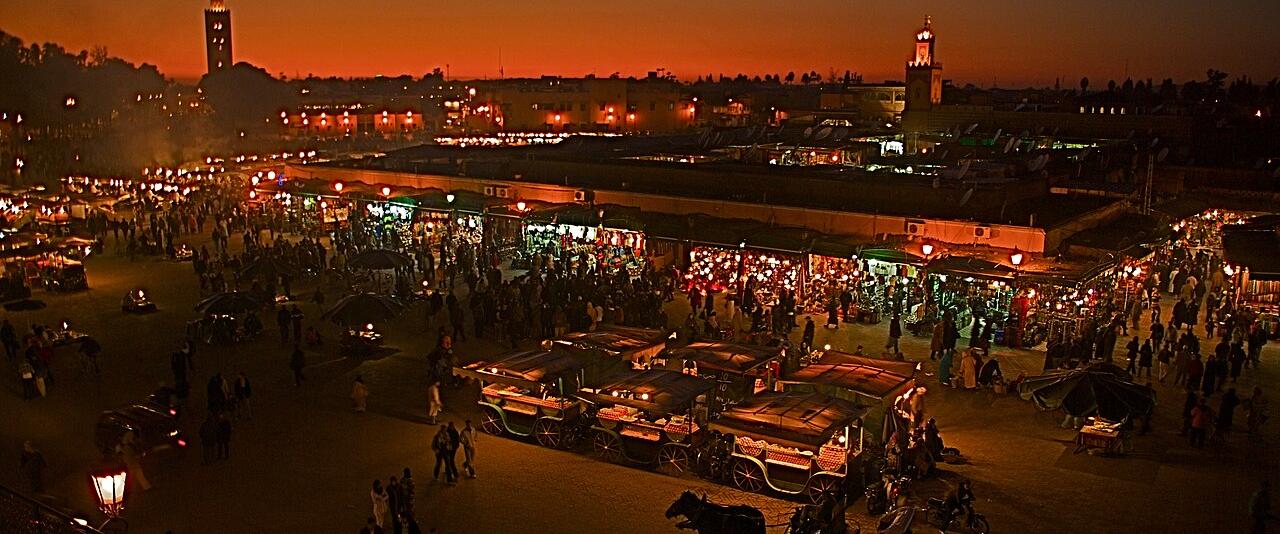
Marrakech is the Red City: rose-coloured walls, the Koutoubia minaret against the Atlas mountains, and every evening the smoke and music of Jemaa el-Fna. Its history is as hard as it is splendid. It was taken by storm, its greatest palace was stripped to the walls by a later sultan, its royal tombs were walled away for two centuries, and its souks once held a market for enslaved Africans. In the 20th century its pasha helped a colonial power depose his own king, and in 2023 an earthquake shook minarets and houses to the ground.
Most of these chapters left something behind that you can still see: the ruins of El Badi, the walled tombs of the Saadians, a Jewish cemetery of more than 20,000 graves. This guide goes through them in order, from 1147 to the present day, and tells you where to find each one.
1147: The City Taken by Storm
Marrakech was founded around 1070 by the Almoravids, a Berber dynasty that ruled from Spain to the Sahara. In 1147 it fell to their rivals, the Almohads, after a long siege. The Almohad leader Abd al-Mu'min had the last Almoravid ruler, a boy named Ishaq ibn Ali, put to death, and his men pulled down the Almoravid mosques and the royal palace.
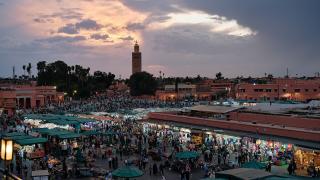
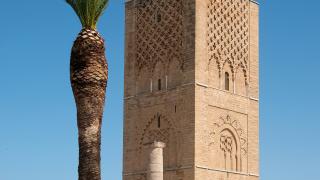
Where to see it today: the Koutoubia Mosque, the city's landmark, was built by the Almohads on the site of the destroyed Almoravid palace. Non-Muslims cannot enter, but you can walk around it and the gardens beside it. The small Qubba Ba'adiyn, a domed pavilion near the Marrakech Museum, is one of the few Almoravid buildings to survive.
The Square of the Dead?
Jemaa el-Fna, the great square at the heart of the medina, has a name that guides love to translate as "the assembly of the dead", with stories of executions and severed heads on display. Historians are more cautious. The square was a place of public punishment in the Middle Ages, but the best-supported explanation of the name is "the mosque of ruin": according to a 17th-century chronicler, a great mosque planned here by the sultan Ahmad al-Mansur was abandoned after plague struck the city, and al-Mansur himself died of it in 1603.
Since 2001 UNESCO has recognised the square, with its storytellers, musicians and healers, as a masterpiece of the oral heritage of humanity.
 Rahba Kedima, the old market square in the souks north of Jemaa el-Fna. Image: Jakub Hałun, CC BY 4.0, via Wikimedia Commons.
Where to see it today: come to Jemaa el-Fna at dusk, when the food stalls light their grills, and watch from one of the café terraces on its edge.
1578–1708: The Palace That Was Stripped
On 4 August 1578, at the Battle of the Three Kings in northern Morocco, the Saadian army crushed an invading Portuguese force; the young king Sebastian of Portugal was killed, and hundreds of Portuguese nobles were taken prisoner. The new sultan, Ahmad al-Mansur, began building a palace in Marrakech that December. El Badi, "the incomparable", was decorated with Italian marble, gold and onyx, and was probably paid for in part by the ransoms of the Portuguese captives.
It did not last. After the Alawite dynasty took power, Sultan Moulay Ismail ordered the palace dismantled in 1707–08 and carried its materials off to build his own capital at Meknes. The stripping went on for years.
 The ruins of El Badi Palace and its sunken garden basins. Image: Jakub Hałun, CC BY 4.0, via Wikimedia Commons.
Where to see it today: the ruins of El Badi, in the Kasbah, are open to visitors. Storks nest on the walls, and exhibition rooms hold the 12th-century minbar (pulpit) of the Koutoubia, made in Córdoba. The palace was cracked by the 2023 earthquake and reopened a month later.
 The 12th-century Almoravid minbar, made in Córdoba for the Koutoubia, now displayed at El Badi. Image: إيان (Minor retouching by Robert Prazeres, CC BY-SA 4.0, via Wikimedia Commons.
The Walled Tombs
The Saadian sultans buried their families in a garden beside the Kasbah Mosque. Ahmad al-Mansur enlarged it with a mausoleum whose Hall of Twelve Columns, carved and tiled, is where he himself lies. More than 100 people are buried in the complex.
When the Alawites came to power, Moulay Ismail had the site walled off from the surrounding streets. It was never quite forgotten, and burials continued for a time, but the tombs were hidden from the city for two centuries. In 1917, under the French Protectorate, the heritage service restored them and opened them to the public for the first time. The popular story that they were rediscovered from the air is a legend.
 The garden of the Saadian Tombs beside the Kasbah Mosque. Image: Jakub Hałun, CC BY 4.0, via Wikimedia Commons.
Where to see it today: the Saadian Tombs, entered by a narrow passage beside the Kasbah Mosque, are open daily from about 9:00 to 17:00. Go early: the queue for the Hall of Twelve Columns grows quickly.
The Slave Market
Marrakech stood at the northern end of a caravan route that ran across the Sahara to Timbuktu, and enslaved people from West Africa were among its cargo. In the 19th century several thousand reached Morocco each year. A French traveller in 1882 described the slave market in the souks: auctions were held three days a week, an hour before sunset, in a courtyard lined with booths. Guidebooks traditionally place it at the Criée Berbère, the small square just north of Rahba Kedima.
The French banned public slave sales after 1912, but private trade continued, and the markets were officially closed only in 1923. Illegal trade went on for about two decades more.
Where to see it today: the Criée Berbère is a carpet auction today. There is no memorial.
1558: The Mellah
In 1558 the Saadian sultan Abdallah al-Ghalib moved the city's Jews to a new quarter beside the royal palace, the mellah. At its peak, in the late 1940s, about 40,000 people lived there. After the founding of Israel in 1948, Moroccan independence in 1956 and the wars of 1967 and 1973, almost all left; about 200 Jews remain in Marrakech today. In 2017 the quarter's historic name, El Mellah, and its Jewish street names were officially restored.
 The Miʿara Jewish cemetery, with more than 20,000 graves. Image: TomiValny, CC BY-SA 4.0, via Wikimedia Commons.
Where to see it today:
- The Lazama synagogue, still in use, with a small museum. The present building dates from the 20th century.
- The Miʿara cemetery, beside the mellah, with more than 20,000 graves. One section holds about 6,000 children who died in a 19th-century typhus epidemic. A donation is expected at the gate.
 Inside the Lazama synagogue in the mellah. Image: David Berkowitz from New York, NY, USA, CC BY 2.0, via Wikimedia Commons.
1912–1956: The Pasha and the King
Morocco became a French protectorate in 1912. In Marrakech the French ruled through Thami El Glaoui, pasha of the city from 1912 until 1956, a Berber lord whose family controlled the High Atlas passes. He grew immensely rich and became one of France's most important allies.
In 1953 El Glaoui led the campaign to depose Sultan Mohammed V, who had come to support Moroccan independence. On 20 August 1953 the French sent the sultan and his family into exile, first to Corsica and then to Madagascar. The exile turned Mohammed V into a national hero, and the resistance grew. In November 1955 El Glaoui knelt before him in France and asked for forgiveness; the sultan returned days later, and Morocco became independent in 1956. El Glaoui died in Marrakech in January 1956, and the state seized his property. Morocco marks 20 August as the "Revolution of the King and the People".
 Thami El Glaoui, pasha of Marrakech, in August 1953, the month the sultan was sent into exile. Image: Fotograaf Onbekend / Anefo, CC0, via Wikimedia Commons.
Where to see it today: Dar El Bacha, El Glaoui's palace northwest of Jemaa el-Fna, built in 1910, is now the Musée des Confluences, with a celebrated coffee house in one of its salons. It was damaged in 2023, so check that it is open. His family's mountain seat, the Kasbah Telouet, is a day trip into the High Atlas.
 The courtyard garden of Dar El Bacha, El Glaoui's palace. Image: R Prazeres, CC BY-SA 4.0, via Wikimedia Commons.
The Years of Lead
Under King Hassan II, from the 1960s to the 1990s, Morocco's opponents were imprisoned, tortured and disappeared in a period Moroccans call the Years of Lead. Marrakech held one of its mass political trials, in 1971, against members of the opposition. In 2004 Morocco created the Equity and Reconciliation Commission, the first truth commission in the Arab world, which examined about 20,000 cases from 1956 to 1999 and published its report in 2006.
Where to see it today: there is no memorial in Marrakech.
8 September 2023: The Earthquake
At 23:11 on 8 September 2023, an earthquake of magnitude 6.8 struck the High Atlas about 70 kilometres southwest of the city. It killed at least 2,960 people, most of them in mountain villages. In Marrakech the minaret of the Kharbouch mosque on Jemaa el-Fna collapsed, houses fell in the mellah and parts of the city walls came down. In the mountains the 12th-century Almohad mosque at Tinmel, one of the most important buildings in Moroccan history, was largely destroyed.
 A mosque in the medina still damaged in 2025. Image: Draceane, CC BY-SA 4.0, via Wikimedia Commons.
Where to see it today: the scars are still visible in the medina, especially in the mellah. Restoration of the Tinmel mosque is under way; it has not reopened.
 The Tinmel mosque in the High Atlas after the 2023 earthquake. Image: Lucyin, CC BY-SA 4.0, via Wikimedia Commons.
Today's Shadows
Most visitors meet a gentler kind of trouble.
- Faux guides. Unofficial guides who lead you "to the square" or to a tannery and then demand money are breaking the law; the tourist police arrest hundreds a year. A polite "no, thank you" and walking on is enough.
- Animals on the square. Barbary macaques, an endangered species, are protected by Moroccan law and international trade in them is banned, yet captive monkeys are still offered for photos on Jemaa el-Fna, alongside snake charmers. Animal-welfare groups ask visitors not to pay for photos.
- Riads and the medina. Thousands of old houses have been turned into guesthouses, many foreign-owned. Whether this has pushed local families out is debated, but it has changed the medina.
- Tourist taxes. A tourism tax and a municipal tax are added to hotel bills per person per night.
How to visit: dress modestly in the medina, ask before photographing people, and don't pay for photos with animals.
How to See Dark Marrakech Respectfully
A self-guided walk, about 4 km. Start at the Koutoubia and its gardens, then cross to Jemaa el-Fna. Walk north into the souks to Rahba Kedima and the Criée Berbère, then back and northwest to Dar El Bacha. Return through the square and head south to the Saadian Tombs by the Kasbah Mosque, then to El Badi. Finish in the mellah, at the Lazama synagogue and the Miʿara cemetery.
Further afield:
- The Kasbah Telouet, El Glaoui's family seat in the High Atlas.
- The Tinmel mosque, in the N'Fis valley on the road to the Tizi n'Test pass, seen from outside while restoration continues.
Dates to know:
- 20 August: the Revolution of the King and the People.
- 8 September: the anniversary of the 2023 earthquake.
- 18 November: Independence Day.
A few ground rules. Mosques are closed to non-Muslims, and the Koutoubia is no exception. The Miʿara cemetery is a working cemetery; don't step on or sit on graves. And remember that the earthquake is recent: many families in the city lost relatives in the mountains.


.jpg)


.jpg)
.jpg)

.jpg)
