Winter is one of the best times to visit Morocco, as long as you pack for cold nights. In Marrakech, December to February afternoons average 19–21 °C under mostly clear skies, but nights drop to 6–8 °C, and in the desert around Merzouga they fall close to freezing. The High Atlas, an hour south of Marrakech, is under snow, and the Atlantic coast around Agadir and Taghazout stays the mildest, with highs around 21–22 °C. For a first winter trip, base yourself in Marrakech, add two or three nights for the drive to the Sahara at Merzouga, and finish on the coast at Essaouira or Taghazout if you want warmer evenings.
What the weather is like, month by month
| Month | Marrakech high / low | Agadir high / low | Errachidia (road to Merzouga) high / low | Rainy days (Marrakech) | |---|---|---|---|---| | November | 23 / 11 °C | 24 / 13 °C | 20.5 / 8 °C | 4 | | December | 20 / 7 °C | 22 / 10 °C | 17 / 3.5 °C | 4 | | January | 19 / 6 °C | 21 / 8 °C | 16 / 2 °C | 3 | | February | 21 / 7.5 °C | 22 / 10 °C | 18 / 4.5 °C | 4 | | March | 23.5 / 10 °C | 23.5 / 12 °C | 22 / 9 °C | 5 |
Figures are 1991–2020 climate averages for Marrakech Menara, Agadir (Inezgane) and Errachidia airports (NOAA climate normals). Marrakech gets well over 200 hours of sunshine a month even in midwinter. Errachidia, on the usual road to the dunes, has recorded lows of −8 °C in January, which tells you what a clear desert night can feel like.
The pattern is simple: warm sun by day, cold after dark, and colder the further you go from the coast and the higher you climb. Riads in Marrakech's medina are built around open courtyards, so rooms can be chilly at night; ask whether yours has heating.
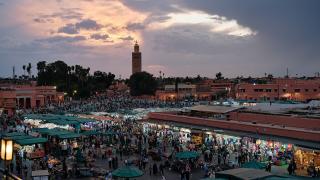
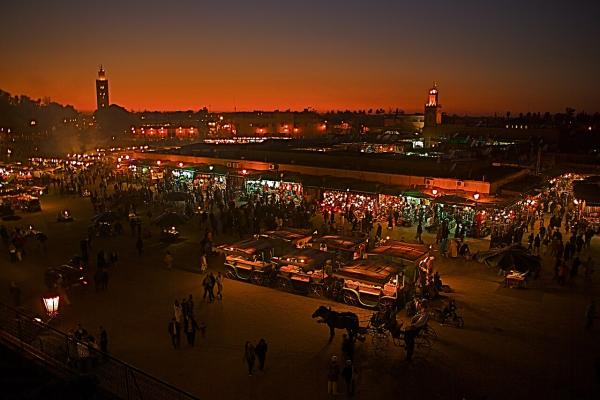
 Jemaa el-Fnaa, Marrakech's main square, under a winter sky. Image: Elgaard, CC BY-SA 4.0, via Wikimedia Commons.
Practical info: Pack a warm jacket, a hat and layers as well as sunglasses and sunscreen. Dress modestly away from beach resorts; long trousers and covered shoulders are also simply warmer in winter.
Marrakech in December and January
December and January are high season in Marrakech, with Christmas and New Year the busiest weeks of the year. Days are comfortable for walking the medina, the souks and the gardens, and the light is clear. Jemaa el-Fnaa, the main square, fills with food stalls and storytellers from late afternoon; in winter that is also when the temperature starts to fall, so bring a layer for the evening.
Morocco is a Muslim country, and Christmas is not a public holiday, but the big hotels and many restaurants catering to visitors hold Christmas and New Year's Eve dinners, and some riads organise their own. Alcohol is served only in licensed hotels, bars and restaurants. Book accommodation for the period from about 20 December to early January well in advance.
Practical info: Marrakech Menara airport is a few kilometres from the medina. The medina is best explored on foot; petit taxis cover the rest of the city. More: Marrakech.
The Sahara at Merzouga: cold nights, clear skies
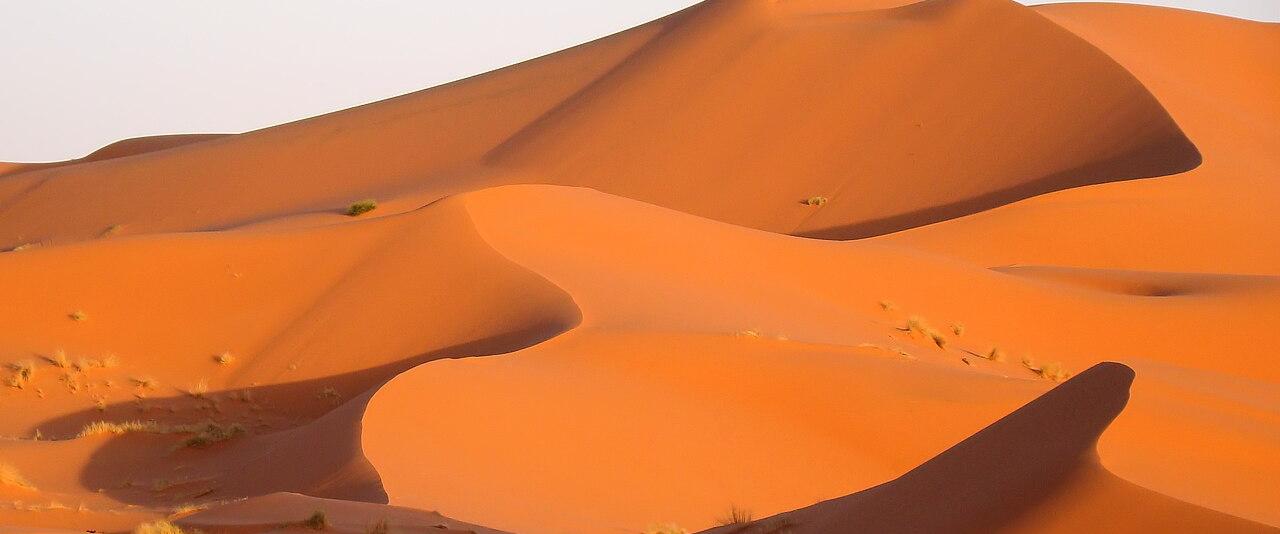
The orange dunes of Erg Chebbi, beside the village of Merzouga in the south-east, are where most visitors see the Sahara. The erg covers about 28 km from north to south and 5–7 km from east to west, along the Algerian border, and its tallest dunes rise about 150 m above the surrounding stony desert. October to April is the season for camel treks, because the summer heat is brutal; winter is the coolest part of that season.
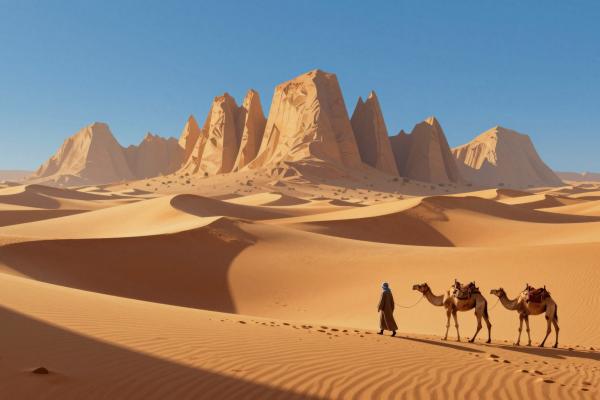
The classic experience is a camel ride into the dunes at sunset, a night in a desert camp and sunrise from the top of a dune. In winter, the night is the hard part: temperatures in this region can fall to around freezing, and a tent in the dunes has no heating beyond blankets and perhaps a fire. Choose a camp with proper beds and plenty of blankets, and take a hat, gloves and a warm layer to sleep in.
 Walkers on the crest of one of the large dunes of Erg Chebbi. Image: Bjørn Christian Tørrissen, CC BY-SA 3.0, via Wikimedia Commons.
Practical info: By road, Merzouga is about 550–560 km from Marrakech, around 8–9 hours of driving over the High Atlas, so almost everyone splits the trip over two or three days via Aït Benhaddou, Ouarzazate and the Dades and Todra gorges. The alternative is a flight to Errachidia (Moulay Ali Cherif airport), which has a limited schedule, followed by about two and a half hours by road. More: Merzouga, and our guides to desert camps and Sahara desert tours.
The road to the desert: Aït Benhaddou, Dades and Todra
The drive from Marrakech crosses the High Atlas by the Tizi n'Tichka pass, at about 2,200 m. Snow often falls on the pass between November and March, so in winter build in some slack, and if a storm is forecast, wait a day rather than push on.
On the far side, the fortified village of Aït Benhaddou, a UNESCO World Heritage Site and a familiar film location, stands above a river near Ouarzazate. Further east, the road threads through two gorges: the Dades, known for its hairpin road climbing out of the valley, and the Todra, where the canyon walls close in to a narrow passage.
 The ksar of Aït Benhaddou, on the old caravan route over the High Atlas. Image: Petar Milošević, CC BY-SA 4.0, via Wikimedia Commons.
 The hairpin bends of the road through the Dades Gorge. Image: Nawfal Kharbach, CC BY-SA 4.0, via Wikimedia Commons.
Practical info: Nights in Ouarzazate and the gorges are cold in winter; small guesthouses vary a lot in how well they are heated, so ask before you book. More: Ouarzazate.
Snow in the High Atlas: Imlil and Toubkal
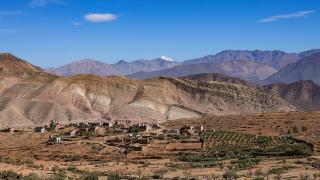
Just south of Marrakech, the High Atlas is at its most dramatic in winter, with snow on the peaks behind the city on clear days. The mountain village of Imlil, at about 1,800 m, sits at the end of the paved road and is the usual starting point for Jebel Toubkal, at 4,167 m the highest peak in North Africa. Winters in Imlil are cold and snowy.
 Snow on the mountains around Toubkal in January. Image: Toubkal4167, CC BY-SA 4.0, via Wikimedia Commons.
For most visitors, the best winter outing is a day trip from Marrakech to Imlil: a walk through the walnut terraces and Berber villages of the valley, lunch with a view of the snow, and back to the city by evening. Climbing Toubkal itself is a different matter in winter. The usual ascent takes two days with a night in a mountain refuge, the upper slopes are covered in snow and ice and can be prone to avalanches, and crampons and an experienced mountain guide are essential.
 A terrace in Imlil looking up the valley towards the High Atlas. Image: Erokhin, CC BY-SA 4.0, via Wikimedia Commons.
Morocco also has a small ski area, Oukaïmeden, about 80 km from Marrakech, with six lifts between roughly 2,600 and 3,200 m. Snow conditions vary a great deal from year to year.
Practical info: Imlil is about an hour and a half by road from Marrakech; tours and private drivers do the return trip in a day. Mountain walks from Imlil need a local guide in winter. More: Imlil, Atlas Mountains, and our Atlas Mountains hiking guide.
Winter sun on the coast: Agadir, Taghazout and Essaouira
Morocco's Atlantic coast is the mildest place in the country in winter. Agadir averages highs of about 21–22 °C from December to February, with only around three rainy days a month and plenty of sunshine, and its long, sandy bay and promenade make it the country's main beach resort. Just north of Agadir, Taghazout is a former fishing village that has become Morocco's surf capital: winter, when the Atlantic swells are biggest, is the main surf season, and surf schools cater for beginners on gentler beaches nearby. The Atlantic is cool at this time of year, so surfers wear wetsuits.
 Sunset over the beach at Taghazout, north of Agadir. Image: Elyassini yassine, CC BY-SA 4.0, via Wikimedia Commons.
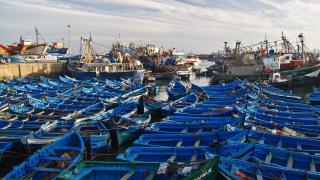
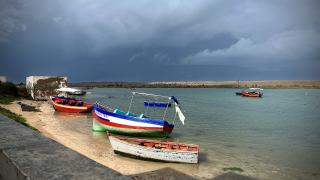
Essaouira, about three hours west of Marrakech by road, is cooler and windier, but its whitewashed medina inside sea walls, a UNESCO World Heritage Site since 2001, is one of the most relaxed towns in Morocco and an easy two- or three-night stop.
 The sea walls and medina of Essaouira on the Atlantic coast. Image: Kayaky, CC BY 3.0, via Wikimedia Commons.
Practical info: Agadir has an international airport, so you can fly into Marrakech and out of Agadir. More: Agadir, Taghazout and Essaouira.
Fès and the north: worth it, but bring a coat
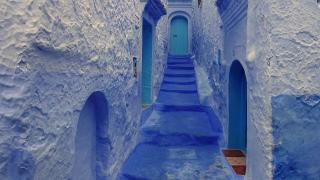
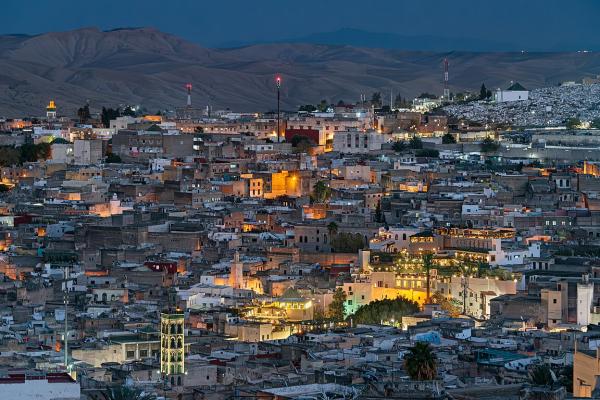
The imperial cities of the north are colder and wetter than Marrakech in winter. Fès averages highs of about 16–17 °C and lows of 4–5 °C from December to February, with rain on six or seven days a month, roughly twice as many wet days as Marrakech (1991–2020 averages for Fès–Saïs airport). Chefchaouen, the blue-washed town in the Rif Mountains, sits at about 600 m and gets far more rain than the south: its annual rainfall that has ranged from about 500 mm to nearly 1,900 mm in recent decades.
None of that is a reason to skip them. The medina of Fès is just as fascinating in the rain, and the winter light suits its tanneries, madrasas and craft workshops, with far fewer visitors than in spring. But plan indoor days, pack waterproof shoes for the slippery medina lanes, and choose a riad with heating. If your trip is only a week and sunshine matters most, keep the north for spring and spend the winter in the south.
Practical info: Fès is connected to Marrakech by train (a long day's journey via Casablanca and Rabat) and by domestic flights. Chefchaouen is reached by road from Fès or Tangier.
New Year in Morocco
New Year's Eve is celebrated by visitors and in the big cities rather than as a national tradition. Marrakech is the busiest place to be: hotels, restaurants and many riads hold gala dinners, and the city is full. A night in the desert is the other popular choice; many camps around Merzouga offer New Year's Eve dinners and music, but they book up early, and a midnight in the dunes in late December is cold. Agadir and Taghazout suit people who want a milder evening outdoors.
Ramadan in winter 2027
Ramadan moves about 11 days earlier each year. In 2027 it is expected to begin around 8 February and to end with Eid al-Fitr around 9–10 March, the exact dates depending on the sighting of the moon. Travelling during Ramadan is perfectly possible: tourist sites stay open, and hotels serve meals, but many local restaurants close during the day, opening hours shorten, and the evenings after sunset are lively. Eat and drink discreetly in public during daylight hours.
Tips for a winter trip
- Pack for two seasons: summer clothes for midday, winter layers for evenings, the mountains and the desert.
- Book Christmas and New Year early, in Marrakech and in the desert camps.
- Allow slack on mountain roads in case of snow on the Tizi n'Tichka.
- Ask about heating in riads and desert camps before you book.
- Combine Marrakech, the desert and the coast for the full range of Morocco's winter.
More on the regions: Marrakech-Safi, Drâa-Tafilalet and Souss-Massa.


.jpg)


