The main options
Accommodation in Morocco falls into a few clear types: riads and dars inside the old medinas, conventional hotels mostly in the modern districts and resorts, family-run guesthouses and auberges in the countryside, restored kasbahs in the south, and camps in the desert. Most itineraries mix several. The right choice depends less on budget than on where you want to be and how you plan to get around.
What a riad is
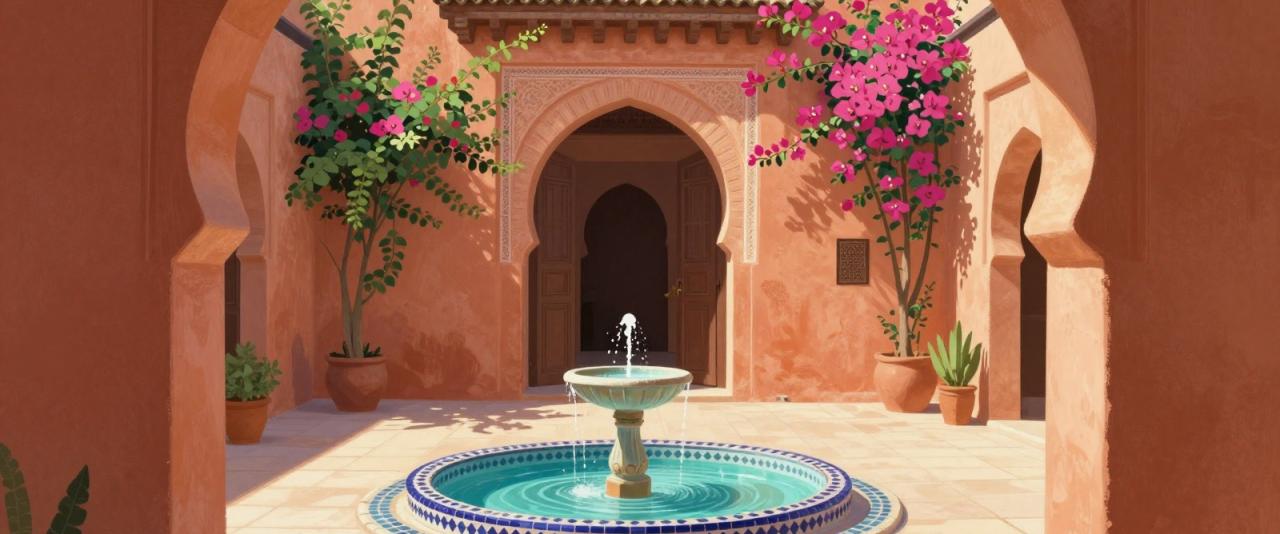
The word riad comes from the Arabic for gardens. Strictly, it refers to a traditional house built around an interior garden courtyard, often laid out in four quarters divided by paths, with a fountain in the centre and citrus trees. Houses built around a simpler open courtyard without a garden are usually called dars, although many guesthouses use "riad" for both.
Over recent decades many old medina houses in Marrakech, Fes, Essaouira and other cities have been restored and converted into small guesthouses. Typical features include zellij tilework, tadelakt plaster walls, carved stucco and a roof terrace. Rooms open onto the courtyard rather than the street, so they are often quiet but can be dim, and sound travels across the open centre.
Why stay in a riad
- Location: you are inside the medina, within walking distance of the souks and monuments.
- Atmosphere: small scale, often fewer than a dozen rooms, with breakfast served in the courtyard or on the roof.
- Help: hosts can book guides, transport, hammams and cooking classes, and many will meet you at a gate when you arrive.
Points to check before booking:
- Access: cars cannot reach most of the medina. Ask where the nearest drop-off point is and whether staff or porters help with luggage.
- Stairs: riads rarely have lifts, and stairs are often steep and narrow. Ask for a ground-floor room if mobility is an issue.
- Temperature: courtyards can be cold and damp in winter and hot in summer. Check for heating and air conditioning.
- Noise: ask about rooms near the courtyard, kitchen or the call to prayer from a nearby mosque.
- Children: pools and open galleries are often unfenced, which matters with small children.
When a hotel makes more sense
Conventional hotels are found mainly in the modern districts (the Ville Nouvelle) of the big cities, near train stations, at airports and in beach resorts such as Agadir. They suit travellers who want:
- Easy car or taxi access, for example with a rental car or an early train.
- Lifts, larger rooms, gyms and bigger pools.
- Predictable standards from international or national chains.
- Space for families or groups who would fill an entire small riad.
For a first visit to Marrakech or Fes, many travellers split their stay: a few nights in a riad in the medina, and one night in a hotel before an early departure.
Guesthouses, kasbahs and desert camps
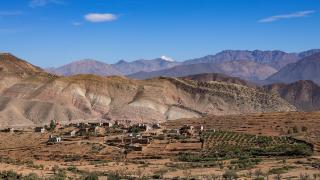
- Mountain guesthouses (gîtes) and auberges: in the High Atlas villages such as Imlil, and in valleys used for trekking, simple family-run guesthouses offer dormitories or private rooms, home-cooked meals and help arranging guides and mules.
- Kasbah hotels: in the south, around Ouarzazate, Skoura and the Dades and Draa valleys, some old earthen kasbahs have been converted into hotels, and new ones are built in the same style.
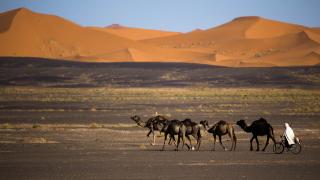
- Desert camps: near the Erg Chebbi dunes at Merzouga and at Erg Chigaga near M'hamid, camps range from basic tents with shared bathrooms to tents with private bathrooms. Most stays include dinner and breakfast.
Practical booking points
- Tourist tax: a local accommodation tax is usually charged per person per night and may not be included in the online price. Ask whether it is.
- Payment: smaller riads and guesthouses may prefer cash or charge a fee for cards. Confirm before arrival.
- Breakfast: usually included in riads and guesthouses; check for hotels.
- Unmarried couples: Moroccan law prohibits sexual relations outside marriage, and hotels may ask Moroccan couples sharing a room for a marriage certificate. Foreign couples are not normally asked, but mixed couples where one partner is Moroccan may be.
- Arrival: send your arrival time and phone number ahead, especially for medina riads, which can be hard to find at night.
- Reviews: read recent reviews for comments on noise, heating, hot water and the walk from the nearest road.
Matching the stay to the trip
For a city break, a riad in the medina offers location and character. For a road trip or a family holiday, hotels and kasbah hotels with parking are easier. In the mountains and desert, guesthouses and camps are often the only options and part of the experience. Mixing types across one itinerary usually gives the best balance of comfort, access and atmosphere.