Choosing how to travel
Morocco has a good intercity rail network in the north and west, a dense long-distance bus system that reaches almost everywhere else, and shared and private taxis that fill the gaps. A rental car makes sense for the mountains and the south, where public transport is slow. Most trips combine two or three of these.
Trains and the Al Boraq high-speed line
The national railway, ONCF, runs a network of around 2,200 km. One main line runs from Tangier through Kenitra, Rabat and Casablanca to Marrakech; another runs east from Rabat through Meknes and Fes to Oujda, with the two lines meeting at Sidi Kacem. Branches serve El Jadida, Safi and Nador. A rail link also connects Casablanca with Mohammed V International Airport.
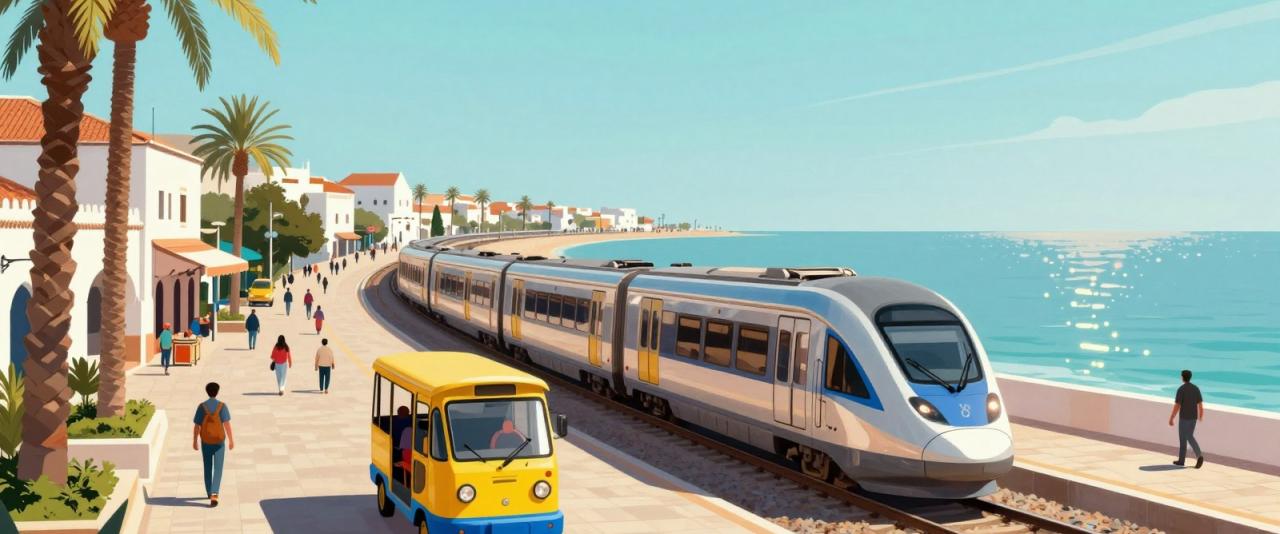
Al Boraq, Africa's first high-speed train, opened in November 2018 between Tangier and Casablanca, with stops at Kenitra, Rabat-Agdal and Casa-Voyageurs. It reaches 320 km/h on the dedicated section between Tangier and Kenitra and cut the Tangier to Casablanca journey from 4 hours 45 minutes to about 2 hours 10 minutes. Trains have first- and second-class cars and a buffet car.
Construction of a high-speed extension from Kenitra to Marrakech via Rabat and Casablanca started in April 2025, with completion targeted for 2029. Until it opens, travel between Casablanca and Marrakech uses conventional trains.
Practical points:
- Book tickets on the ONCF website or app, or at station counters. Al Boraq seats are assigned and can sell out on Fridays, Sundays and around holidays.
- In Rabat, the high-speed trains stop at Rabat-Agdal; many conventional trains also stop at Rabat-Ville, which is closer to the medina.
- First class on conventional trains guarantees a seat, which is worth it on busy routes.
Places the train does not reach
Agadir, Essaouira, Chefchaouen, Ouarzazate, Merzouga and the Atlas valleys have no railway. ONCF's bus company, Supratours, runs connecting coaches from rail stations to several of these destinations, and through tickets can be bought together with the train.
Long-distance buses
The two main national coach companies are CTM and Supratours. Both have their own stations or offices in most cities, numbered seats, luggage holds with a small baggage fee, and online booking. They are the usual way to reach places like Chefchaouen, Essaouira and the southern desert towns. Journeys to the Sahara are long, so overnight buses are common.
Cheaper private bus companies operate from the main city bus stations. They are less predictable on timing and comfort, and buying a ticket in a busy terminal can be confusing for first-time visitors.
Petit taxis and grand taxis
- Petit taxis are small city cabs, limited to their city and carrying a maximum of three passengers. Insist on the meter or agree the fare before getting in. Drivers often pick up other passengers going the same way.
- Grand taxis are larger cars that run fixed routes between towns, leaving when every seat is filled, or can be hired privately for a whole trip. They are often the quickest way to reach smaller places, and paying for empty seats speeds up departure and gives more room.
The UK Foreign Office notes that cars booked through ride-hailing apps may be unregulated and unlicensed, and that police can tell passengers to leave an unlicensed taxi. Licensed taxis are the safer choice.
Renting a car
A car gives the most freedom in the High Atlas, the Draa and Dades valleys and the desert. International and local rental companies have desks at the main airports and in the larger cities. Traffic drives on the right. Check with the rental company which licence documents they require, read the insurance terms carefully, and inspect the car for damage before leaving the lot.
Things to know before driving:
- Mountain roads such as the N9 over the Tizi n'Tichka pass between Marrakech and Ouarzazate are slow, with hairpin bends and heavy vehicles, so allow more time than the distance suggests.
- Police checkpoints and speed controls are frequent, especially at town entrances. Keep the car documents and your licence to hand.
- Avoid driving at night outside cities, when pedestrians, animals and unlit vehicles are hard to see.
- Do not drive a car into a medina. Park outside and walk, or use a guarded car park.
Putting a route together
A typical first trip can use the train for the Tangier, Rabat, Casablanca, Fes and Marrakech triangle, then switch to a bus, private driver or rental car for the mountains, the desert and the coast south of Casablanca. Booking key legs in advance matters most at weekends and during Moroccan school holidays.