Morocco's best-known Roman site
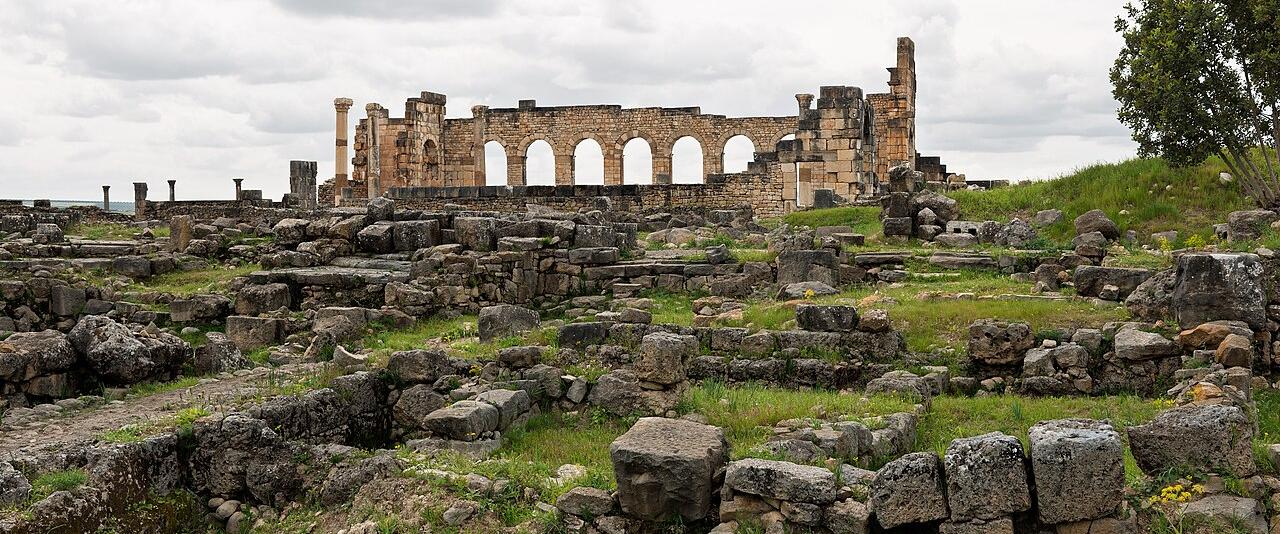
Volubilis lies on fertile plains below the Zerhoun massif, north of Meknes, and is the most extensive Roman archaeological site in Morocco. It began as a Berber settlement in the 3rd century BC, became an important city of the kingdom of Mauretania, and grew quickly after Rome annexed the region in AD 44. At its peak in the late 2nd century it covered about 42 hectares and had around 20,000 inhabitants.
Rome withdrew around 285, but the city stayed inhabited. Idris I, founder of the Idrisid dynasty, established himself here in 788 before power shifted to Fes. Later, stone was taken for the building of Meknes, and the 1755 earthquake caused heavy damage. French excavations through the first half of the 20th century uncovered much of what you see today, and UNESCO listed the site in 1997. About half of it has been excavated.
Why go in winter
Volubilis is an open site with almost no shade. In summer, the midday heat on the stone paths can be punishing. Winter brings cooler days that are much more comfortable for a long walk around the ruins, softer light for photographs, and fewer visitors on many days. The surrounding fields are green after the rains, and the hills of Zerhoun often have clear views.
The trade-offs are shorter daylight hours, the chance of rain, and cold mornings and evenings in this inland region. Check the forecast, start in the morning, and plan to be done before late afternoon.
What to see
Allow two to three hours to walk the main circuit. Highlights include:
- The basilica and forum. The early 3rd-century basilica is one of the finest Roman basilicas in Africa, and its columns are the site's best-known silhouette.
- The Capitoline Temple, dedicated to Jupiter, Juno and Minerva, standing above the forum on a raised platform.
- The Arch of Caracalla, built in 217 and partly reconstructed in the 1930s, at the head of the main street, the Decumanus Maximus.
- The mosaics. Several houses still have floor mosaics in place, including the House of Orpheus, with its Orpheus mosaic, the House of the Labours of Hercules, showing the hero's tasks, and the House of the Knight, with Bacchus and the sleeping Ariadne.
- Olive presses. Remains of numerous oil presses show that olive oil was central to the city's wealth, and olive groves still surround the site.
Many of the finest bronze finds, including a well-known bust of Cato the Younger, are displayed in the Rabat Archaeological Museum rather than on site, so a visit to that museum makes a good companion if you are passing through the capital. Licensed guides are usually available at the entrance and add a lot of context to the houses and mosaics.
Getting there
Volubilis is roughly 30 km north of Meknes, and Meknes is the most practical base.
- From Meknes. Shared grand taxis run to Moulay Idriss Zerhoun, the holy town about 3 to 5 km from the site; from there you can take a short taxi or walk. Alternatively, hire a grand taxi for a round trip from Meknes with waiting time, agreeing the price and duration in advance.
- From Fes. Volubilis is a common day trip from Fes, often combined with Moulay Idriss and Meknes, either with a hired driver or an organised tour. Check whether tour prices include site entry.
- From Rabat. There is no direct public transport. The usual approach is to take the train from Rabat to Meknes, then continue by grand taxi. As a day trip it is long; staying a night in Meknes or Fes is more comfortable. If you want Roman ruins in Rabat itself, the Chellah, site of the ancient town of Sala, sits within the city.
Opening hours and entry fees change, so check them locally before you go.
Combining with Moulay Idriss and Meknes
Moulay Idriss Zerhoun, built on two hills above the plain, holds the tomb of Idris I and is one of Morocco's most important pilgrimage sites. Non-Muslims cannot enter the shrine, but the town and its viewpoints are worth a walk. Meknes, a former imperial capital under Moulay Ismail, has monumental gates such as Bab Mansour and makes a natural overnight stop.
What to pack
- Layers and a waterproof jacket for changeable winter weather.
- Sturdy shoes; paths are uneven and slippery after rain.
- Sun protection, since there is little shade even in winter.
- Water and a snack, as facilities at the site are limited.
- Cash for entry, guides and taxis.
Next steps
- Decide on your base: Meknes for independence, Fes for organised day trips.
- Check current opening hours and the weather forecast.
- Arrange transport the day before.
- Pair the visit with Moulay Idriss, and with the Rabat Archaeological Museum if your route passes through the capital.