A fortified village that keeps getting cast
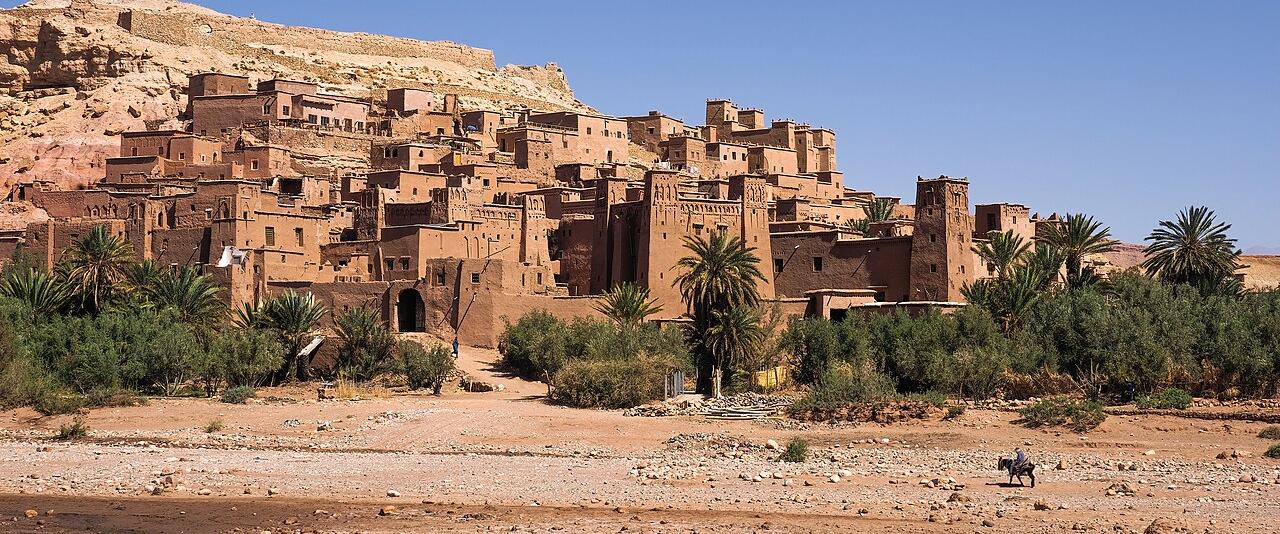
Aït Benhaddou is a ksar, a fortified village of earthen houses and towers, stacked up a hillside above the Ounila River in Ouarzazate Province. The site has been fortified since at least the Almoravid period, and it sat on the trans-Saharan trade route that linked the desert with Marrakech over the High Atlas via the Tizi n'Tichka pass. UNESCO inscribed it as a World Heritage Site in 1987 as an outstanding example of southern Moroccan earthen architecture.
That same architecture is what film crews want. From a distance the ksar reads as a generic ancient city: no visible modern buildings, mud-brick walls the colour of the surrounding hills, and a granary at the summit that frames a skyline. Combined with reliable sunshine and the film infrastructure that grew up around nearby Ouarzazate, it has become one of the most filmed villages in North Africa.
The films, decade by decade
The list of productions that have used the ksar or its surroundings is long. Highlights include:
- 1960s: Lawrence of Arabia (1962), Sodom and Gomorrah (1963) and Pasolini's Oedipus Rex (1967).
- 1970s: The Man Who Would Be King (1975), The Message (1976) and the miniseries Jesus of Nazareth (1977).
- 1980s: Time Bandits (1981), The Jewel of the Nile (1985), the James Bond film The Living Daylights (1987) and The Last Temptation of Christ (1988).
- 1990s: The Sheltering Sky (1990), Kundun (1997) and The Mummy (1999).
- 2000s onwards: Gladiator (2000), Alexander (2004), Kingdom of Heaven (2005), Babel (2006), Prince of Persia (2010), Son of God (2014) and Queen of the Desert (2015).
On television, the ksar appears in Game of Thrones, where it was used for scenes set in the slaver cities of Essos, and it has also featured in the Brazilian telenovela O Clone and in Outer Banks. Its role is often anonymous: it stands in for Jerusalem, for ancient Egypt, for a Roman province or for an invented desert city rather than playing itself.
What you will and won't see
It helps to set expectations. Most productions dressed the ksar temporarily or added digital set extensions, and those additions were removed when filming ended. You will not find a Roman arena from Gladiator or intact sets from The Mummy in the village. What you can recognise are the shapes: the stepped walls, the zigzag path to the top, the view across the riverbed and the earthen towers that make so many establishing shots.
Some souvenir sellers and guides point out spots they associate with particular scenes. Treat these claims loosely unless you have checked the scene yourself, since locations have been reshot, recombined and digitally altered across many productions. Rewatching a film or two before the trip is the easiest way to spot real matches.
Visiting the ksar
The ksar itself is now home to only a few families. Most residents moved to the modern village across the river, where the cafés, car park and shops are. A pedestrian bridge completed in 2011 crosses the riverbed and replaced the old stepping-stone crossing, which could be awkward when the river was running.
From the bridge you climb through lanes between houses, some of which open as small shops or private houses that ask for a small fee to look inside. The path ends at the ruined agadir (collective granary) on the hilltop, which gives the classic view over the Ounila valley. The climb is short but steep and uneven, with no shade at the top, so morning and late afternoon are the most comfortable times, and the low light at those hours is also what made the ksar popular with cinematographers.
Wear shoes with grip, carry water and remember that people still live here. Ask before photographing residents and keep drones on the ground unless you have the required authorisation, since drone use in Morocco is tightly regulated.
Linking it with Ouarzazate's studios
Ouarzazate, roughly half an hour's drive away, is the base for most of the region's film work and has large studio lots on its outskirts where sets from various productions have been built. Some studios have offered visitor tours in recent years; check current arrangements locally before you plan around one. Even without a studio visit, the drive along the valley gives a sense of why location scouts like the area, with kasbahs, palm groves and bare mountains within a short radius.
Most travellers reach Aït Benhaddou on the road between Marrakech and Ouarzazate via the Tizi n'Tichka pass, either as a stop on a desert tour or with a rental car. The mountain road is slow and winding, so allow plenty of time and avoid driving it after dark.
Making the most of the visit
- Go early to avoid tour groups arriving from Marrakech around midday.
- Stay overnight in the area if you can; the ksar is quieter and better lit at sunrise and sunset.
- Watch at least one of the films beforehand to recognise the skyline.
- Respect the earthen structures: do not climb on walls, as mud-brick is fragile and repairs depend on traditional skills.
The film credits are the hook for many visitors, but the ksar is worth the stop on its own terms as one of the best preserved earthen villages in Morocco.