Why Casablanca is different
Casablanca is Morocco's largest city and its business and financial centre, and it feels like it: wide boulevards, office towers, heavy traffic and a population that moves quickly. Many travellers pass through only because Mohammed V International Airport is the country's main long-haul gateway. With some planning, though, a day or two here is easy to manage and gives a side of Morocco that the old imperial cities do not.
The key is knowing how the city's transport fits together. Casablanca is spread out, and the sights are far enough apart that walking between all of them is not realistic.
Arriving: airport and trains
Mohammed V International Airport lies well south of the city centre. The national rail operator ONCF runs trains from a station beneath the terminal into Casablanca, stopping at the main city stations, and the same line connects onward to other cities. Taxis from the airport are the alternative; agree the fare before getting in or use the official taxi rank.
Casablanca has two central rail stations that matter for visitors:
- Casa Voyageurs is the main long-distance station and the Casablanca terminus of Al Boraq, Morocco's high-speed train. Since 2018 Al Boraq has linked Casablanca with Rabat (Rabat-Agdal), Kenitra and Tangier, cutting the Tangier journey to a little over two hours. Conventional trains from Casa Voyageurs serve Marrakech, Fes and Meknes.
- Casa Port is close to the old medina and the port, and is handy for trains towards Rabat and the north.
Book Al Boraq on the ONCF website or app, especially for Friday and Sunday travel, when trains fill up.
Getting around the city
Casablanca's tram network is the easiest way to cover long distances. It now has four lines, with line T3 and line T4 added in 2024 to the original two. Line T1 passes Casa Voyageurs and the United Nations Square near the Central Market, and line T2 runs out to the Aïn Diab beach area on the Corniche. Tickets are rechargeable cards bought from machines on the platforms and validated at the turnstiles. Busway lines complement the trams on some corridors.
For short hops, red petits taxis circulate everywhere. They should use the meter; if a driver refuses, find another cab. Petits taxis can pick up other passengers going the same way, which is normal. Ride-hailing apps also operate in the city.
Traffic is heavy at rush hour, so leave margin before a train.
What to see
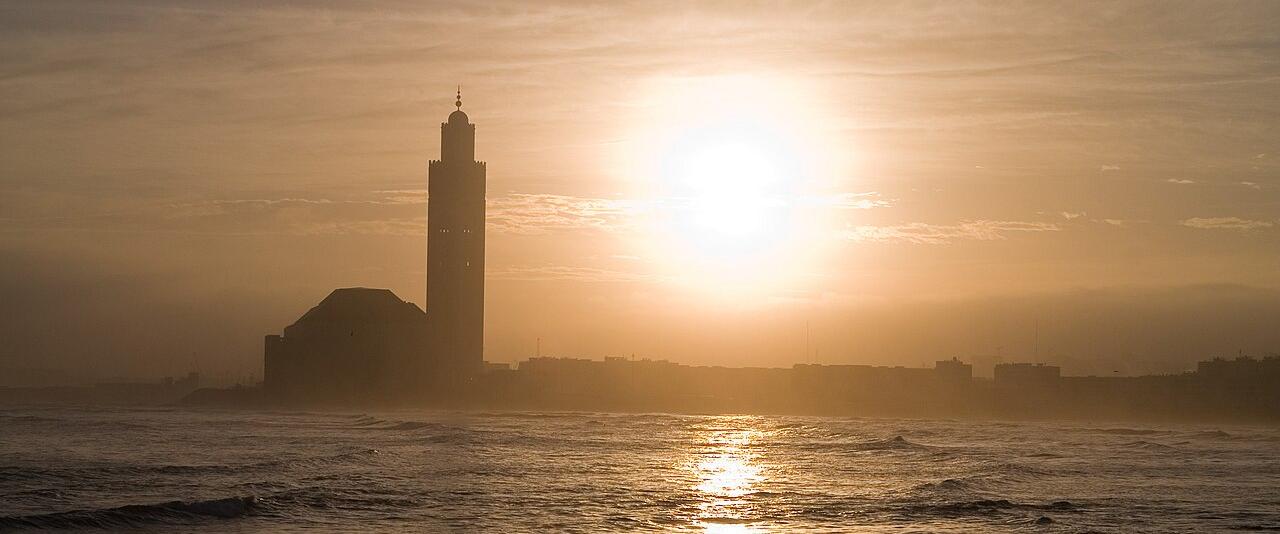
- Hassan II Mosque. Completed in 1993 on a platform partly built over the Atlantic, it has a minaret 210 metres high and space for about 25,000 worshippers inside and many more in the courtyard. It is one of the few mosques in Morocco that non-Muslims can enter, on guided tours; check current tour times and dress requirements before you go. The complex also has a museum.
- Art deco and colonial-era centre. The streets around Mohammed V Boulevard, the Central Market and the Place Mohammed V contain a large collection of early 20th-century buildings combining art deco with Moroccan decoration. A walk here is free and shows why the city attracts architecture enthusiasts.
- Quartier Habous. The "new medina" was built in the 1930s in a traditional style, with arcaded streets, bookshops and pastry shops. It is calmer than the old medinas in other cities and a comfortable place for browsing.
- The Corniche and Aïn Diab. The seafront west of the mosque has beaches, a promenade and restaurants. It is where many residents go in the evening and at weekends.
- The old medina. Smaller and more workaday than those of Fes or Marrakech, but it links the port area with the city centre.
Staying safe and comfortable
Casablanca is a large city with the usual urban risks. Keep phones and wallets out of easy reach in crowded areas and on trams, use registered taxis at night and avoid quiet streets late in the evening. Dress is more varied than in smaller towns, but modest clothing is still expected at religious sites.
Choose your base by plan. Near Casa Voyageurs or the city centre suits a short stopover between trains; the Corniche suits a slower stay with sea air and evening walks.
A simple one-day plan
- Morning: guided visit to the Hassan II Mosque, then a walk along the seafront.
- Midday: tram or taxi to the city centre for lunch near the Central Market.
- Afternoon: an architecture walk around Mohammed V Boulevard, then the Quartier Habous.
- Evening: back to the Corniche for sunset and dinner.
Next step: check train times to your next destination and book Al Boraq seats in advance if you are heading north.