The Dades Gorge is one of the two great limestone canyons on the southern side of Morocco's High Atlas, the other being the Todra Gorge to the east. It is less a single sight than a valley you travel up: a narrow road follows the Dades River north from the town of Boumalne Dades, past kasbahs, almond and walnut terraces and red rock walls, before squeezing into the gorge proper. This guide covers how the valley is laid out, what to see on the road, the walks worth doing, and how to fit it into a route through southern Morocco.
Where the Dades Gorge Is
The gorge sits in Tinghir Province, in the Drâa-Tafilalet region. The gateway town is Boumalne Dades, about 1,560 metres above sea level on the N10, the main road that runs east from Ouarzazate through Kalaat M'Gouna (the rose-growing town) to Tinghir. At Boumalne a side road, the R704, turns north and climbs into the valley.
The Dades River rises in the High Atlas and eventually joins the Draa at the edge of the Sahara. In the gorge it has cut through sedimentary rock that was laid down on an ancient sea floor and later lifted by the same tectonic movement that raised the Atlas. The walls rise roughly 200 to 500 metres, and the valley floor in the gorge section is around 1,800 metres high, so it is noticeably cooler than Ouarzazate or the desert.
The Road Up the Valley
The first part of the drive from Boumalne runs through a green, inhabited valley. Villages of packed-earth houses and old kasbahs line the river, with small fields, poplars and fruit trees on the terraces below. Several stretches are known for their rock formations: rounded, eroded ridges that change colour through the day.
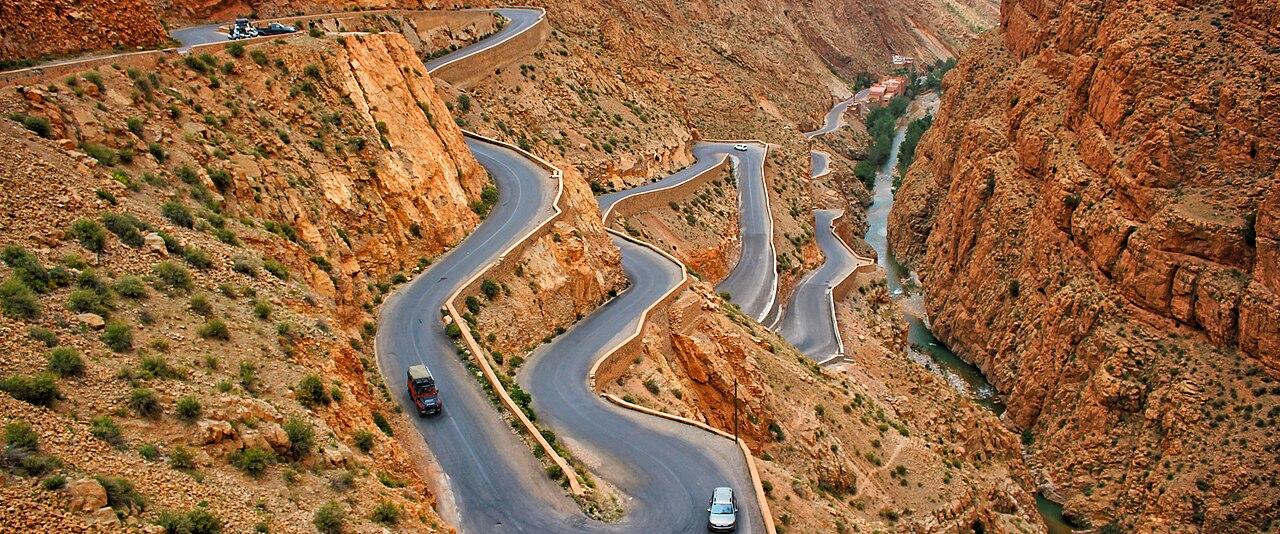
Roughly 25 to 30 kilometres up from Boumalne, the valley narrows into the gorge itself. Here the road runs between high walls beside the river and then climbs out over the Tisdrine switchbacks, a tight series of hairpin bends that has become the best-known photograph of the valley. Cafés at the top overlook the bends, and most visitors driving a day trip turn around here.
The road is paved to the switchbacks and beyond, but it is narrow, with blind corners, minibuses and livestock. Drive slowly, use the horn on blind bends, and avoid driving it in the dark if you are not used to mountain roads.
Beyond Tisdrine: Msemrir and the High Route to Todra
Past the switchbacks the valley continues north towards Msemrir, a larger village in the upper Dades. From that area, mountain roads and tracks cross the high plateau east towards Agoudal and then drop south to the top of the Todra Gorge. Parts of this loop have been paved in recent years, but conditions vary by section and season; floods and snow can close it. Ask locally before attempting it in a hire car, and treat it as a full day.
The simpler way to see both gorges is via the N10: from Boumalne it is about 50 kilometres east to Tinghir, and the Todra Gorge begins about 15 kilometres north of Tinghir. Many travellers stay one night in each valley.
Walks in the Valley
The Dades is good walking country, and many guesthouses can arrange a local guide.
- Monkey Fingers (Doigts de Singe): A popular half-day walk in the lower valley explores a side canyon of rounded, finger-like rock formations near the villages of Aït Arbi and Tamellalt. Routes cross the river and pass through the village before entering narrow passages; guided versions run to about three hours.
- Ridge and village walks: Paths climb from the road to viewpoints above the river and link villages on the far bank. These are informal trails, so a local guide is useful.
- Upper gorge walks: Around and above Tisdrine, paths follow side valleys away from the road.
Carry water and sun protection, wear proper footwear, and avoid narrow canyons if rain is forecast anywhere upstream; flash floods are the main hazard in these valleys.
When to Go
Spring (March to May) and autumn (September to November) are the most comfortable seasons, with mild days and green or golden valley colours. Summer days are warm but less extreme than the desert, which makes the gorge a reasonable stop on a summer route. Winter nights are cold, and snow is possible higher up, so bring warm layers between December and February.
Where to Stay and How to Get There
Accommodation is spread along the R704, from small family guesthouses to restored kasbahs and larger hotels, and many have terraces over the river. Staying in the valley rather than in Boumalne lets you see the gorge early in the morning and in the evening light. Book ahead in spring and autumn.
Without a car, take a bus along the N10 to Boumalne, then a shared grand taxi or minibus up the valley; transport thins out after the gorge section. With a car, Dades fits naturally between Ouarzazate and the Todra Gorge on the way to Merzouga and the Erg Chebbi dunes.