Agadir is one of the warmest places in Morocco in winter: from December to February, daytime highs average 21–22 °C and nights fall to about 8–10 °C, with only around three rainy days a month and well over 200 hours of sunshine. That makes it a reliable winter-sun beach town, though the Atlantic is cool and evenings call for a jacket. Almost everything visitors come for stays open through the season, from the beach and promenade to the rebuilt Agadir Oufella kasbah, the Souk El Had and the surf breaks at Taghazout.
This guide covers the weather month by month, the sea, what to do, day trips, and what Christmas and New Year are like in a Muslim country. For the rest of the country in the same season, from Marrakech to the Sahara, see our guide to Morocco in winter.
Quick facts (checked October 2026)
- Average highs: 24 °C in November, 22 °C in December, 21 °C in January, 22 °C in February.
- Rain: around 3 days a month with 1 mm or more, December the wettest.
- Sea: cool, a wetsuit for surfing and a brisk swim for everyone else.
- Closed days: Souk El Had shuts on Mondays.
- Public holidays: 1 January, 11 January (Independence Manifesto Day) and 14 January (Amazigh New Year). Christmas is not a public holiday.
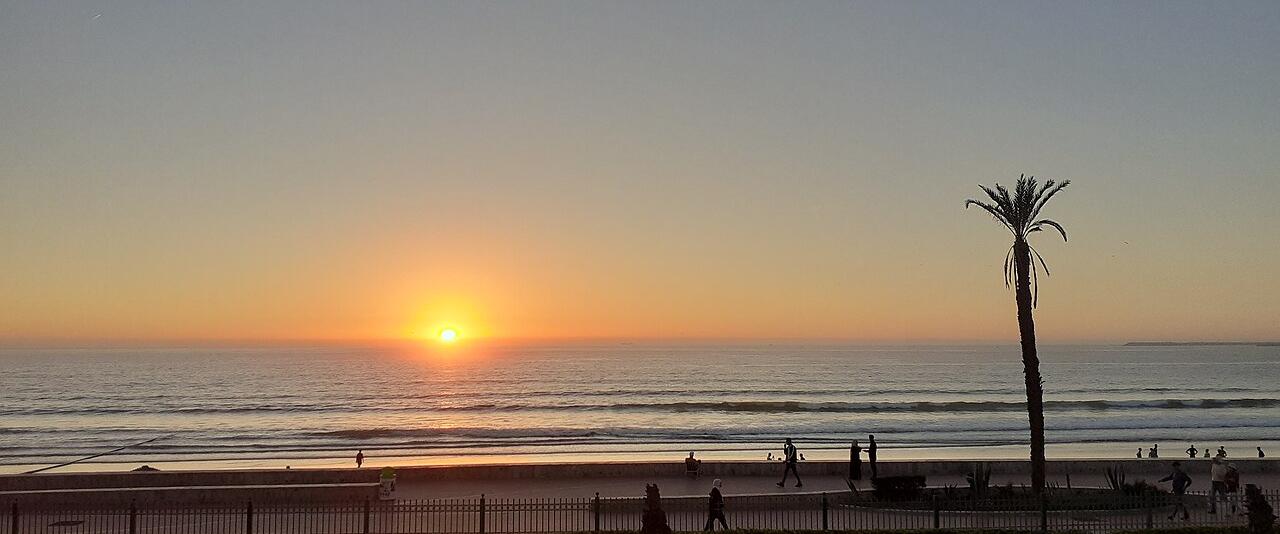
 Dusk over Agadir's bay and beach promenade in November. Image: Ideophagous, CC0, via Wikimedia Commons.
What is the weather like in Agadir in winter?
Agadir faces the Atlantic, and the cool ocean keeps its winters mild and its summers moderate. These are the 1991–2020 averages for the Agadir (Inezgane) weather station, from the US National Oceanic and Atmospheric Administration's climate normals:
| Month | Average high | Average low | Rain (mm) | Rainy days | Sunshine (hours) |
|---|---|---|---|---|---|
| November | 24.1 °C | 12.9 °C | 42 | 3.0 | 228 |
| December | 22.1 °C | 10.1 °C | 49 | 3.6 | 222 |
| January | 21.2 °C | 8.4 °C | 32 | 2.8 | 235 |
| February | 22.0 °C | 10.1 °C | 29 | 2.7 | 225 |
| March | 23.4 °C | 12.3 °C | 31 | 3.2 | 267 |
In practice that means sunny mornings that warm up quickly, comfortable afternoons on the beach in a T-shirt, and a noticeable drop once the sun goes down, when you will want long sleeves or a light jacket. January nights are the coldest, and many budget hotels and apartments have no heating, so ask before you book. When rain does come it tends to arrive in a few heavy days rather than as steady drizzle.
Inland is a different story: the Anti-Atlas and High Atlas behind Agadir are colder, and the High Atlas has snow in winter.
Can you swim in Agadir in winter?
You can, but the sea is cool. The Atlantic here never reaches Mediterranean warmth even in summer, and in winter most people find it bracing: a quick swim on a sunny afternoon rather than a long float. Surfers at Taghazout wear full wetsuits. We could not find an official sea-temperature record for Agadir, so we do not quote a figure.
Agadir's beach is a long, sandy bay, about ten kilometres of seafront according to Morocco's national tourist office, with a promenade (the Corniche) running most of the way. The Atlantic has strong waves and currents, so swim where other people are swimming and lifeguards are present, and stay out of the water when red flags are flying.
Agadir Oufella: the rebuilt kasbah
The hilltop kasbah of Agadir Oufella, above the port at the northern end of the bay, was the old fortified town of Agadir until the earthquake of 29 February 1960 destroyed it along with most of the city. For decades only the walls remained. A restoration programme rebuilt the ramparts and reopened the site in stages: the outer areas opened to visitors in July 2022, and the area inside the walls opened on 3 February 2024, according to Moroccan press reports. The visit inside follows a raised wooden walkway along the lines of the old streets, takes about fifty minutes, and comes with audioguides in Arabic, Amazigh, French, English and Spanish. A memorial to the victims of the earthquake is part of the site.
The kasbah is the best viewpoint in Agadir: the port, the bay and the city spread out below, and on the hillside underneath is the giant Arabic inscription "God, Country, King". Winter's clear afternoons are a good time to go; it is windy and cool on top, so bring a layer.
Getting there: a cable car (téléphérique) runs up from the city near the Tildi bridge and went into service in July 2022. You can also go up by taxi or bus, or walk a waymarked 2.8 km path. Check the current opening hours and ticket prices on site, as we could not find them on an official page.
 The port of Agadir and the bay seen from the walls of Agadir Oufella. Image: Abdeaitali, CC BY-SA 4.0, via Wikimedia Commons.
 The Agadir cable car climbing towards the kasbah. Image: Tovamg, CC BY-SA 4.0, via Wikimedia Commons.
Souk El Had
Souk El Had (the name means "Sunday market") is Agadir's huge walled market on the eastern side of the city centre, with thousands of stalls selling fruit and vegetables, spices, argan oil, olives, household goods, leather, clothing and crafts. It is where people from Agadir actually shop, which makes it far more interesting than the souvenir shops on the seafront. It is closed on Mondays and busiest on Sundays, when families come from the surrounding villages. Go in the morning for the produce halls at their fullest, agree prices before you buy, and keep your phone and wallet in a front pocket in the crowded aisles. Opening hours can change during Ramadan and religious holidays.
 Bab Demnate, one of the gates of Souk El Had. Image: Anass Sedrati, CC BY-SA 4.0, via Wikimedia Commons.
Paradise Valley
Paradise Valley is a palm-lined gorge in the Ida Outanane mountains inland from Agadir, with rock pools in a river that runs over pink and grey stone. It is a popular half-day or day trip by car, taxi or organised tour, and winter is a pleasant time to walk there, as the summer heat is gone. The pools are cold, and after heavy rain the river can rise fast: if there has been a storm, do not swim and stay off the river bed. The rest of the year, wear proper shoes for the rocky paths.
 Palms and a rock pool in Paradise Valley in the Ida Outanane mountains. Image: Younes GOUSSYRA, CC BY-SA 4.0, via Wikimedia Commons.
Taghazout and the winter surf season
Taghazout, a former fishing village about twenty minutes up the coast from Agadir, is the centre of Moroccan surfing, and winter is its main season, when the North Atlantic swells are biggest. The point breaks around Taghazout and the neighbouring beaches suit experienced surfers in winter, while surf schools take beginners to gentler beach breaks nearby; ask before paddling out anywhere unfamiliar. Even if you do not surf, the village and its beach, with the fishing boats pulled up on the sand, make an easy afternoon trip, and the area around Taghazout Bay has filled up with hotels and cafés in recent years.
 Fishing boats on the beach at Taghazout. Image: Heather Cowper from Bristol, UK, CC BY 2.0, via Wikimedia Commons.
Day trips from Agadir
- Taroudant (about 80 km east): a walled market town in the Souss valley, often called "little Marrakech", with ochre ramparts you can walk or drive around and a slower pace than Agadir. Winter days are warm enough to explore on foot.
- Essaouira (about 175 km north on the coast road): an old walled port with a whitewashed medina, ramparts over the sea and a working fishing harbour. It is windier and a little cooler than Agadir, so take a jacket. Most people stay at least one night.
- The Souss-Massa National Park, south of Agadir, protects coastal wetlands and dunes, and the Oued Massa estuary is one of the country's best winter birdwatching sites.
 The ramparts of Taroudant, a day trip east of Agadir. Image: Hamza Izourane, CC BY-SA 4.0, via Wikimedia Commons.
Christmas and New Year in Agadir
Morocco is a Muslim country, and Christmas is not a public holiday: shops, markets and offices are open as usual on 25 December. The big beach hotels, which cater to European visitors escaping the winter, put on Christmas and New Year's Eve dinners, and you will see decorations in hotels and some cafés, but there is little in the streets. Alcohol is served only in licensed hotels, bars and restaurants and some supermarkets, and public drunkenness is frowned upon.
1 January is a public holiday in Morocco, as are 11 January, Independence Manifesto Day, and 14 January, the Amazigh (Berber) New Year, Yennayer, a paid national holiday since 2024. The Souss region around Agadir is one of the heartlands of Amazigh culture, so look out for local celebrations around mid-January.
Late December to early January is the busiest stretch of the winter season, with prices to match: book flights and hotels early.
Ramadan in February 2027
Ramadan moves about eleven days earlier each year, and in 2027 it falls in late winter: it is expected to begin around 8 February 2027 and end with Eid al-Fitr in early March, the exact dates depending on the sighting of the new moon. Travelling in Agadir during Ramadan is easy. Beach hotels and many tourist restaurants keep serving during the day, while local cafés and restaurants may close until sunset, and the evenings after the fast is broken are lively. Be discreet about eating, drinking and smoking in public in daylight.
When is the best time to visit Agadir in winter?
- November and March are the warmest of the cooler months, with highs around 23–24 °C, fewer crowds than the holidays and lower prices.
- December and January have the shortest days and the coolest nights, and Christmas to New Year is the most expensive period.
- February is mild and sunny, but in 2027 it overlaps with Ramadan, which makes little difference in the beach hotels and more in the city.
What to pack
Pack for summer by day and autumn by night: light clothes, a warm layer, a windproof jacket for the kasbah and the beach at dusk, and closed shoes for Paradise Valley. Sun cream matters even in January, as the sun is strong. For walking in the city and the souk, clothes that cover shoulders and knees are respectful and, after dark, warmer too.